
THE LIVING ARCHIVE OF ANTONIO COLOMBO
DESIGN Rationalist Furniture
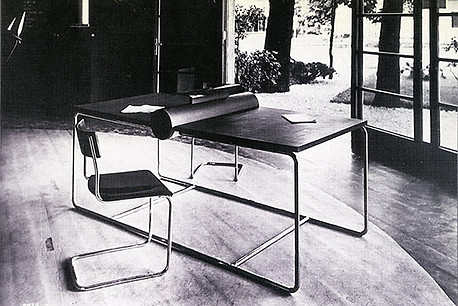
The tubular-metal furniture produced by A.L. Colombo from 1933 until the mid-1960s represents one of the most significant chapters in the history of modern Italian design.
The story begins with the acquisition of the exclusive licence to manufacture in Italy furniture by Zurich-based Wohnbedarf, developed in collaboration with some of the leading figures of the Modern Movement, including Alvar Aalto, Sigfried Giedion, Werner Moser, Alfred Roth and Flora Steiger. Marcel Breuer’s contribution was especially important. From the mid-1920s at the Bauhaus, he explored the innovative potential of tubular steel, helping to define an entirely new language for modern living.

1919 A.L. Colombo is founded as a craft-based company specialising in precision steel tubing.
1919/1927 Production includes tubular components for aircraft and seaplane equipment (Caproni / transatlantic flights), tubing for bicycle frames, ski bindings and posts for tennis courts.
1932/1933 The company acquires exclusive rights from Embru and Wohnbedarf (Switzerland) to manufacture furniture by Marcel Breuer.
1933 The Columbus brand is created for the production of chrome-plated tubular-steel furniture. Its manufacturing activity is supported by an extensive programme of communication and advertising at cultural events and trade fairs, together with a constant presence in both specialist and general publications.
This strategy brings Columbus furniture to a wide audience, particularly the pieces that would become its “classics”: flexible chairs and stools with wooden seats, developed by the company’s Technical Department and produced in large numbers throughout the 1930s.
Collaborating architects: Enrico Moroni, Ercole Faccioli, Piero Bottoni, Giuseppe Terragni, Luigi Figini and Gino Pollini, Giuseppe Pagano.
At the 5th Milan Triennale, held at the Palazzo dell’Arte, Enrico Prampolini uses Columbus furniture for the “Station for a Civil Airport” inside the Futurist Pavilion.
At the same Triennale, the Gruppo dei Comaschi selects Columbus furniture for the artist’s studio in the “Holiday House for an Artist on the Lake”.
The company imports textiles from Hungary through Eva Szabo.


At the same time, A.L. Colombo collaborated with some of the leading Italian architects of the period – including Giuseppe Pagano, Giuseppe Terragni and Piero Bottoni – taking part in landmark events such as the Milan Triennales of 1933 and 1936 and contributing to the interiors of significant architectural projects.
Today, Colombo’s Archive preserves a unique and invaluable record of this remarkable chapter in Italian manufacturing: a heritage that traces the evolution of Italian industrial design through original furniture, prototypes, works in progress, drawings, catalogues, photographs and printing plates.
An archive that bears witness to the convergence of technical innovation, design culture and entrepreneurial vision.

1936 For the “Waiting Room of a Doctor’s Surgery”, Piero Bottoni experiments with several armchair solutions based on an original crossed elastic suspension system. For the first time, he also uses Pirelli foam rubber, a material that would transform upholstered-furniture production in post-war Italy.
At the same edition, the “Living Room” designed by Bramante Buffoni and Leonardo Spreafico, furnished with Columbus pieces, receives an award.
1939 Production of springs and mattresses begins under the Igea-Columbus brand.
1940 Columbus furniture enters a period of major success, particularly in communal environments such as offices, canteens and schools, including the University of Rome.
1965 Production of Columbus Rationalist furniture comes to an end.